
Yard Operations

Reviewing observed yard activity and inferred visits so a supervisor can direct work with a clear view of what the capture does and does not establish.
In the application
- Open Dashboard, set the project and period, and read the asset and scan totals for the shape of the day.
- Open Assets to see individual readings, most recent first.
- Compare arrivals and departures over the same window to understand activity. Their difference is not a count of equipment currently on site: the opening population, repeated readings, pairing and capture completeness all matter.
From an assistant
Using SiteTrax.io, summarize activity at my sites for the last seven days and break it down by asset type and direction.
Using SiteTrax.io, were there any unusual volume gaps at my sites this week?
Using SiteTrax.io, compare inferred trailer occupancy at entry with completed visit durations for this project and period. Confirm the gate pair, timezone and maximum valid visit duration. Show the sample size, average, median and p90 duration by occupancy band, explain incomplete observations and capture limitations, and link the supporting visits.
Use SiteTrax.io server-side sequence analysis for this question. It estimates concurrent observed visits at entry for one equipment family: containers, chassis or trailers. These units must not be relabeled as trucks, and USDOT numbers cannot identify individual visits. Occupancy is inferred from bounded observations and pairing assumptions, not a verified physical inventory. A last observation alone does not prove current presence.
A rise in duration across occupancy bands is an exploratory association. It does not establish that occupancy caused the delay or set a verified yard capacity limit. The analysis can report insufficient samples or withhold a change-point estimate while relevant visits remain incomplete. Review those qualifications before acting on a threshold.
Coverage is the limiting factor
Yard visibility is only as complete as the capture behind it. The Intelligence hub states this directly: if you chose yard visibility in your profile, it will tell you that which working zones are covered is not yet confirmed, and prompt you to map what is already visible and close only the gaps that remain.
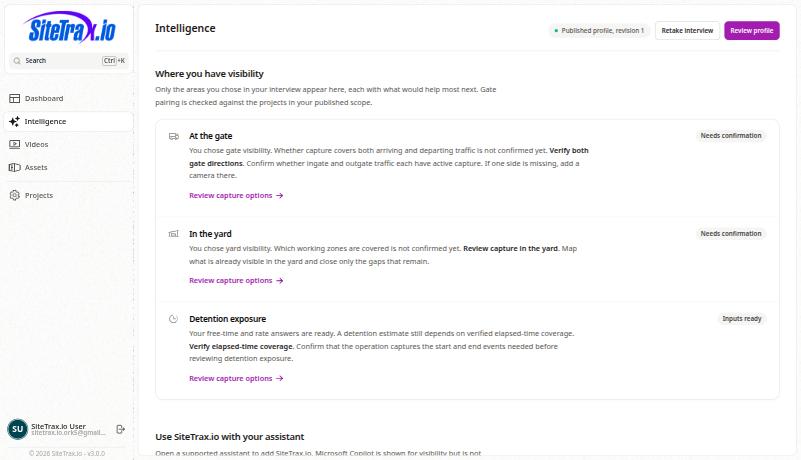
Do that exercise before treating a yard count as complete. A zone with no camera contributes nothing to the record, and no amount of analysis recovers it.
Watch out for
- Absence of a reading is not absence of a unit. It is absence of an observation.
- Dwell needs boundaries. Observed durations describe eligible completed visits. Unmatched, expired, superseded and still-open visits are reported separately; gaps in capture can prevent a calculation or limit how representative it is.
- Combined processing adds rows. Where container and chassis are processed together, a synthetic row can be stored for the paired side.
No comments to display
No comments to display