
Enabling Intelligence

What has to be true before a team gets value from Intelligence, in the order it makes sense to do it.
1. Confirm the accounts
Everyone needs their own SiteTrax.io account, with email verification completed before authorizing an external assistant. Share the projects they need. An account can authorize MCP without a published profile, but useful operational answers require shared projects; an empty project list is not itself an authentication failure.
2. Confirm the capture
Intelligence reports what was observed. Before rollout, settle whether each gate has capture on both directions and which yard zones are covered. Doing this first prevents a team concluding the product is wrong when the real finding is a blind spot.
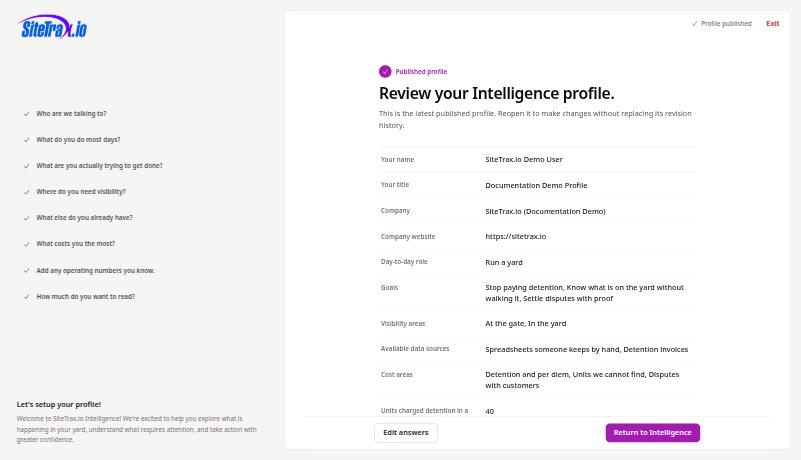
3. Have each person publish a profile
The personalized Intelligence hub becomes available once that account publishes the profile interview and Intelligence is enabled. Until publication, the normal hub route opens the interview and the Intelligence navigation item is hidden. This portal setup is independent of OAuth: people can connect a supported external assistant and query their shared projects without publishing a profile.
Ask people to answer honestly rather than aspirationally. The interview asks what costs them the most and where they need visibility; an accurate answer produces a useful coverage review, and a flattering one does not.
4. Decide the assistant position
Your assistant workspace may require an authorized owner or administrator to enable a connection. Confirm the applicable requirements in your provider’s dedicated setup section before rollout. Each user still authorizes the intended SiteTrax.io account.
Each person then authorizes their own assistant connection with their SiteTrax.io account. Decide whether they need to create or cancel alerts and digests; only those changes require the additional notifications write scope. Listing notifications and delivery history uses read access. The extra permission may be requested initially or later, depending on the client. See Account Access and OAuth and Alerts and Scheduled Digests.
5. Retire the old references
Update runbooks, bookmarks, onboarding material and saved links that point at service.sitetrax.io. The current application is app.sitetrax.io.
A rollout that works
- Start with one site and a handful of people who feel a specific pain, such as detention disputes.
- Have them publish profiles and work the coverage review to a conclusion.
- Choose one assistant platform for the pilot, then have each person authorize their own SiteTrax.io account and compare the returned project list with the application.
- Compare an assistant answer against the application for the first week until the team trusts it.
- Expand once they can explain the difference between a reading and an event.
No comments to display
No comments to display